
Lecture 7: Eigenvalues and Diagonalization
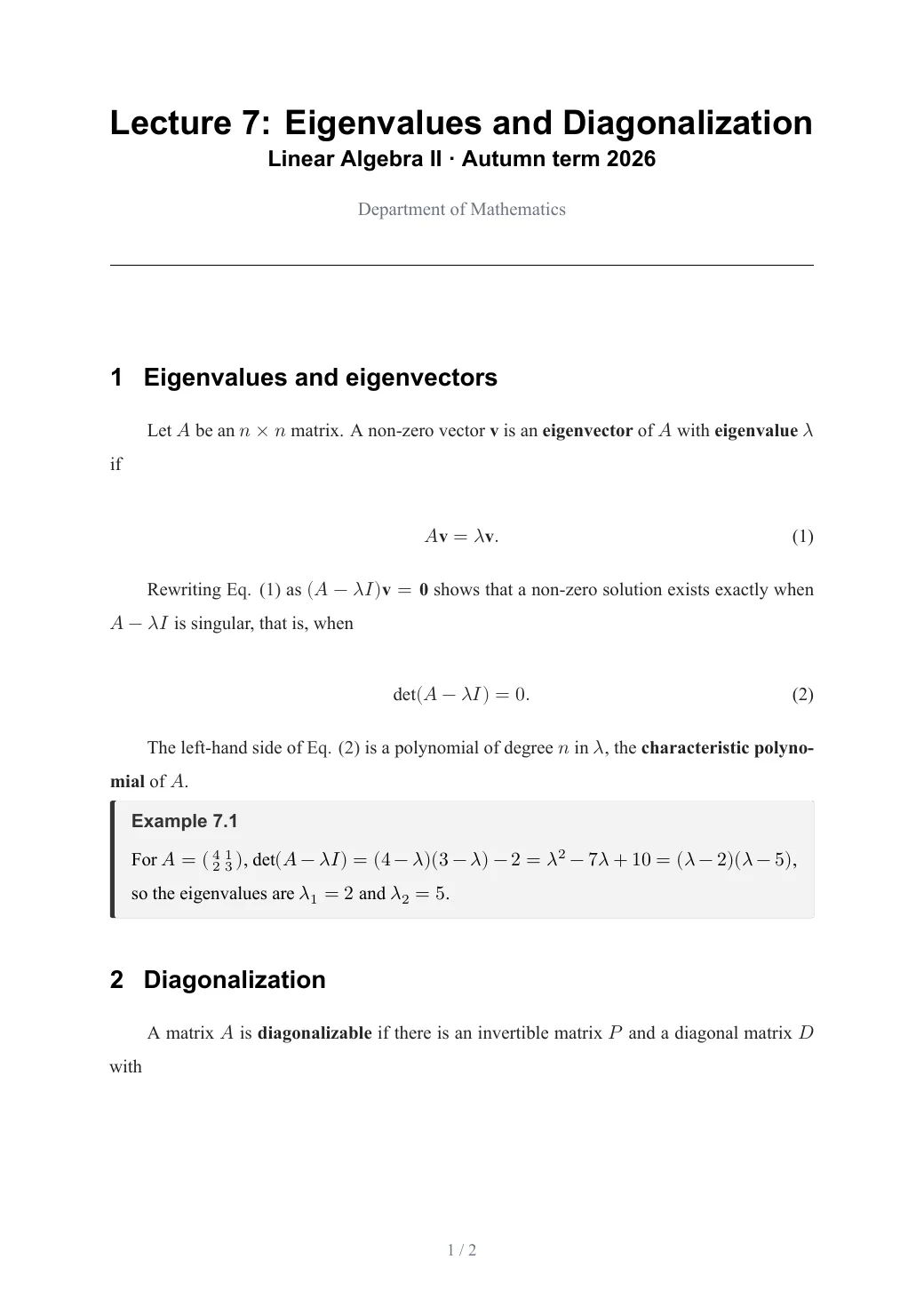
Lecture notes on eigenvalues: numbered sections and equations, matrices, a theorem box, footnotes and exercises.
Download the source, unzip it and drop the folder onto the converter — then change the text to make it yours.
Open the converter---
title: "Lecture 7: Eigenvalues and Diagonalization"
subtitle: Linear Algebra II · Autumn term 2026
author: Department of Mathematics
number-sections: true
---
# Eigenvalues and eigenvectors
Let $A$ be an $n \times n$ matrix. A non-zero vector $\mathbf{v}$ is an **eigenvector** of $A$ with **eigenvalue** $\lambda$ if
$$
A\mathbf{v} = \lambda \mathbf{v}.
$$ {#eq:eig}
Rewriting [@eq:eig] as $(A - \lambda I)\mathbf{v} = \mathbf{0}$ shows that a non-zero solution exists exactly when $A - \lambda I$ is singular, that is, when
$$
\det(A - \lambda I) = 0.
$$ {#eq:char}
The left-hand side of [@eq:char] is a polynomial of degree $n$ in $\lambda$, the **characteristic polynomial** of $A$.
::: {.tip title="Example 7.1"}
For $A = \left(\begin{smallmatrix} 4 & 1 \\ 2 & 3 \end{smallmatrix}\right)$,
$\det(A - \lambda I) = (4-\lambda)(3-\lambda) - 2 = \lambda^2 - 7\lambda + 10 = (\lambda - 2)(\lambda - 5)$,
so the eigenvalues are $\lambda_1 = 2$ and $\lambda_2 = 5$.
:::
# Diagonalization
A matrix $A$ is **diagonalizable** if there is an invertible matrix $P$ and a diagonal matrix $D$ with
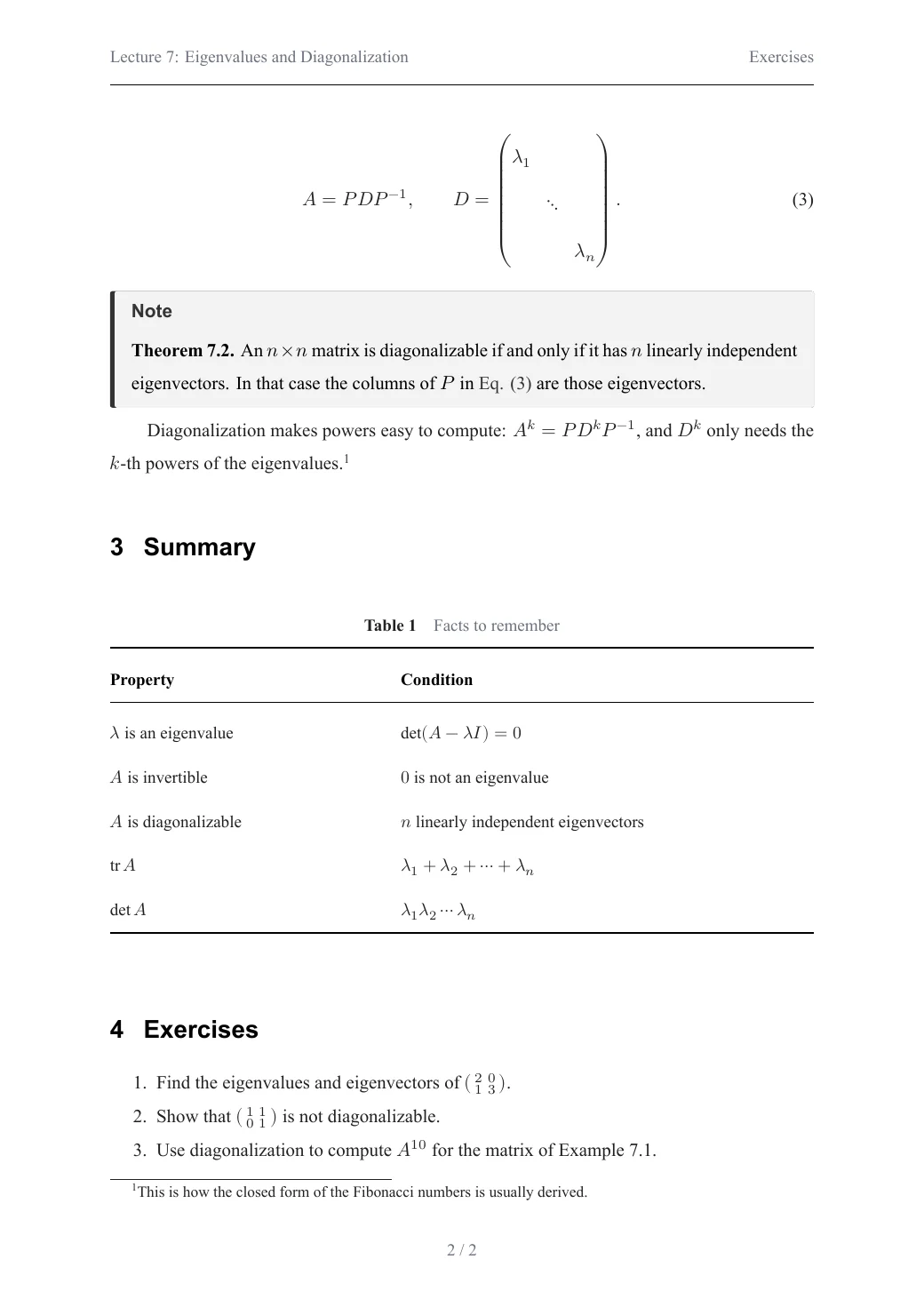
$$
A = P D P^{-1}, \qquad D = \begin{pmatrix} \lambda_1 & & \\ & \ddots & \\ & & \lambda_n \end{pmatrix}.
$$ {#eq:diag}
> [!NOTE]
> **Theorem 7.2.** An $n \times n$ matrix is diagonalizable if and only if it has $n$ linearly independent eigenvectors. In that case the columns of $P$ in [@eq:diag] are those eigenvectors.
Diagonalization makes powers easy to compute: $A^k = P D^k P^{-1}$, and $D^k$ only needs the $k$-th powers of the eigenvalues.[^power]
[^power]: This is how the closed form of the Fibonacci numbers is usually derived.
# Summary
| Property | Condition |
|-----------------------------|--------------------------------------------|
| $\lambda$ is an eigenvalue | $\det(A - \lambda I) = 0$ |
| $A$ is invertible | $0$ is not an eigenvalue |
| $A$ is diagonalizable | $n$ linearly independent eigenvectors |
| $\operatorname{tr} A$ | $\lambda_1 + \lambda_2 + \cdots + \lambda_n$ |
| $\det A$ | $\lambda_1 \lambda_2 \cdots \lambda_n$ |
: Facts to remember
# Exercises
1. Find the eigenvalues and eigenvectors of $\left(\begin{smallmatrix} 2 & 0 \\ 1 & 3 \end{smallmatrix}\right)$.
2. Show that $\left(\begin{smallmatrix} 1 & 1 \\ 0 & 1 \end{smallmatrix}\right)$ is not diagonalizable.
3. Use diagonalization to compute $A^{10}$ for the matrix of Example 7.1.← All examples · All names, companies and figures in these examples are made up.