
Design: Rate Limiting for the Export API
An engineering design document with code in two languages, a formula, tables and a rollout plan.
Download the source, unzip it and drop the folder onto the converter — then change the text to make it yours.
Open the converter---
title: "Design: Rate Limiting for the Export API"
subtitle: Engineering design document · RFC-0142
author: Platform Team
date: 2026-10-20
---
# Summary
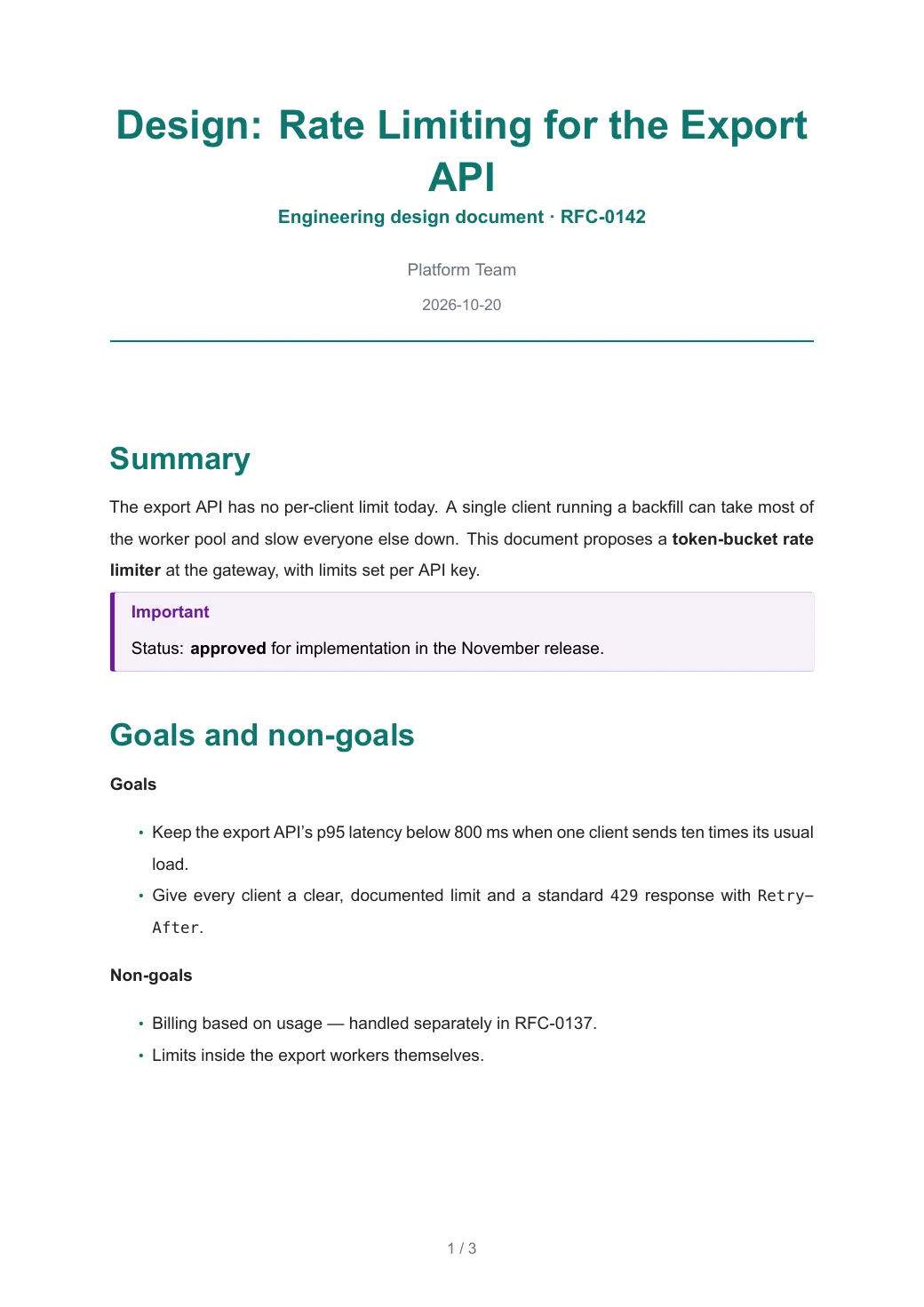
The export API has no per-client limit today. A single client running a backfill can take most of the worker pool and slow everyone else down. This document proposes a **token-bucket rate limiter** at the gateway, with limits set per API key.
> [!IMPORTANT]
> Status: **approved** for implementation in the November release.
# Goals and non-goals
**Goals**
- Keep the export API's p95 latency below 800 ms when one client sends ten times its usual load.
- Give every client a clear, documented limit and a standard `429` response with `Retry-After`.
**Non-goals**
- Billing based on usage — handled separately in RFC-0137.
- Limits inside the export workers themselves.
# Design
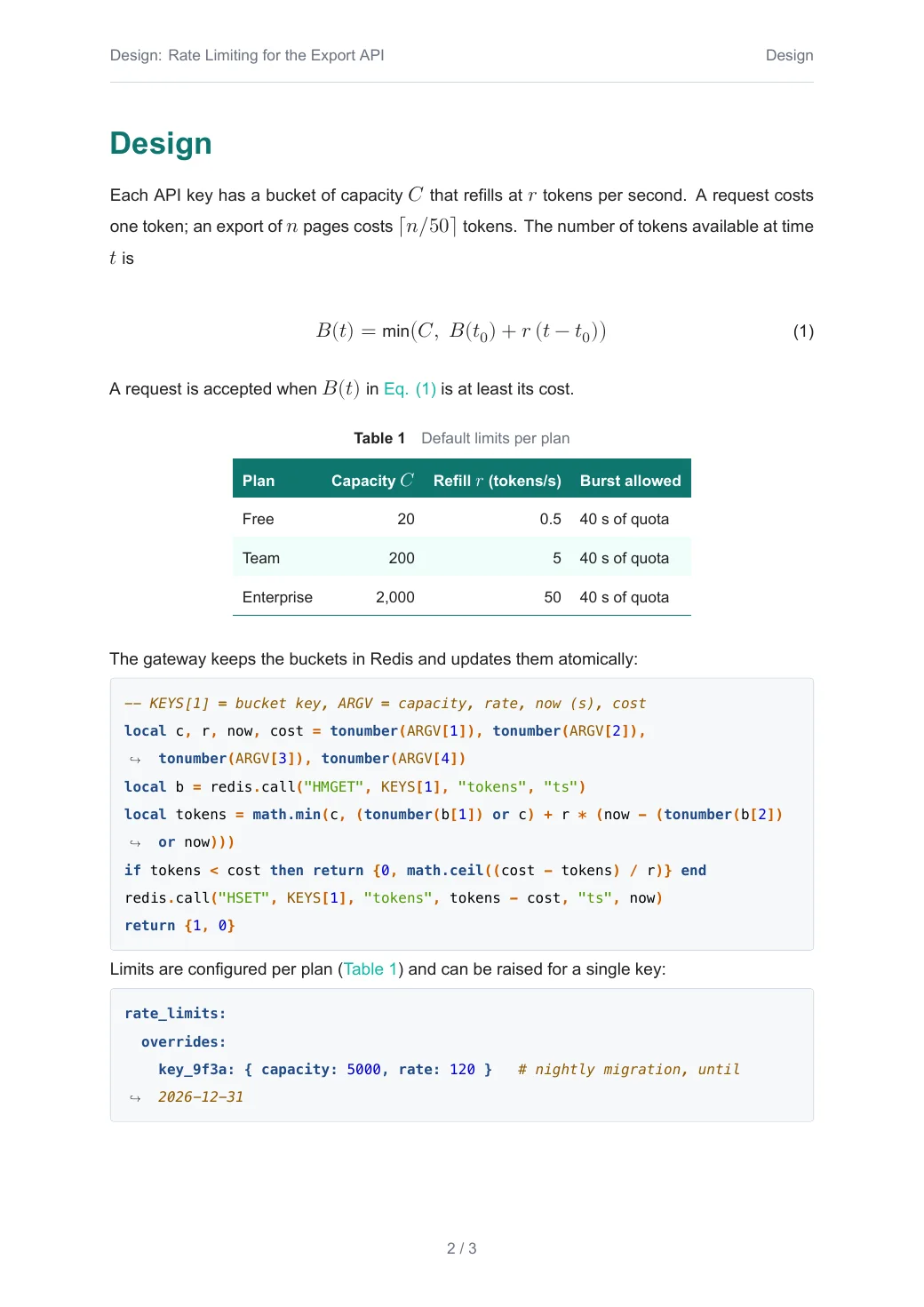
Each API key has a bucket of capacity $C$ that refills at $r$ tokens per second. A request costs one token; an export of $n$ pages costs $\lceil n / 50 \rceil$ tokens. The number of tokens available at time $t$ is
$$
B(t) = \min\bigl(C,\; B(t_0) + r\,(t - t_0)\bigr)
$$ {#eq:bucket}
A request is accepted when $B(t)$ in [@eq:bucket] is at least its cost.
| Plan | Capacity $C$ | Refill $r$ (tokens/s) | Burst allowed |
|------------|-------------:|----------------------:|---------------|
| Free | 20 | 0.5 | 40 s of quota |
| Team | 200 | 5 | 40 s of quota |
| Enterprise | 2,000 | 50 | 40 s of quota |
: Default limits per plan {#tbl:limits}
The gateway keeps the buckets in Redis and updates them atomically:
```lua
-- KEYS[1] = bucket key, ARGV = capacity, rate, now (s), cost
local c, r, now, cost = tonumber(ARGV[1]), tonumber(ARGV[2]), tonumber(ARGV[3]), tonumber(ARGV[4])
local b = redis.call("HMGET", KEYS[1], "tokens", "ts")
local tokens = math.min(c, (tonumber(b[1]) or c) + r * (now - (tonumber(b[2]) or now)))
if tokens < cost then return {0, math.ceil((cost - tokens) / r)} end
redis.call("HSET", KEYS[1], "tokens", tokens - cost, "ts", now)
return {1, 0}
```
Limits are configured per plan ([@tbl:limits]) and can be raised for a single key:
```yaml
rate_limits:
overrides:
key_9f3a: { capacity: 5000, rate: 120 } # nightly migration, until 2026-12-31
```
# Rollout
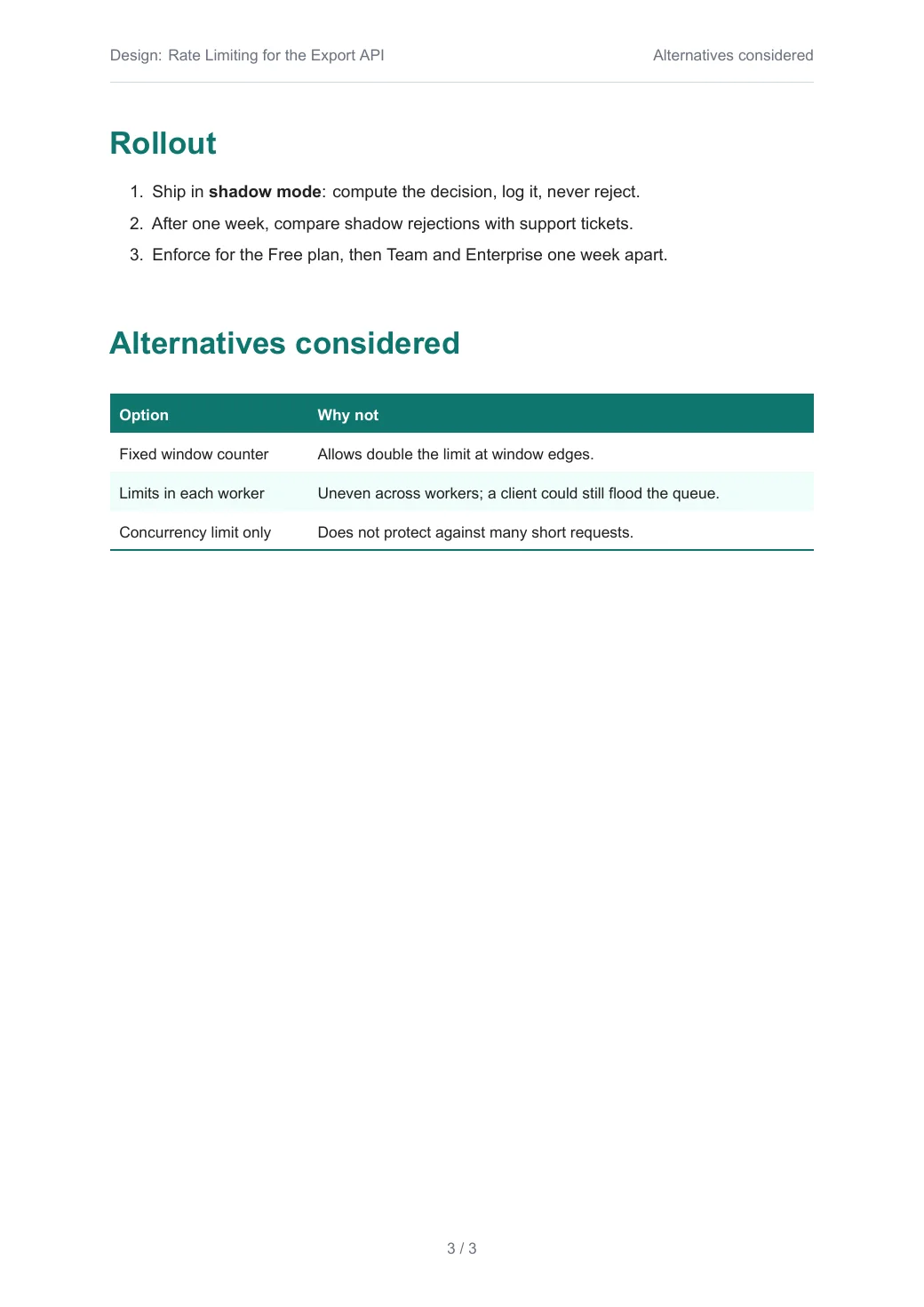
1. Ship in **shadow mode**: compute the decision, log it, never reject.
2. After one week, compare shadow rejections with support tickets.
3. Enforce for the Free plan, then Team and Enterprise one week apart.
# Alternatives considered
| Option | Why not |
|------------------------|-----------------------------------------------------------------|
| Fixed window counter | Allows double the limit at window edges. |
| Limits in each worker | Uneven across workers; a client could still flood the queue. |
| Concurrency limit only | Does not protect against many short requests. |← All examples · All names, companies and figures in these examples are made up.